Lily English, Harry’s mistress of almost 30 years, died in May 1922 in New Cross, London aged only 56. Harry’s two children by her were now in their twenties; Winnie (26) and Jack (23).
Find out more in Lily English and Harry and Lily English.
Leaves From An Unwritten Diary, the life and times of Sir Harry Preston
Lily English, Harry’s mistress of almost 30 years, died in May 1922 in New Cross, London aged only 56. Harry’s two children by her were now in their twenties; Winnie (26) and Jack (23).
Find out more in Lily English and Harry and Lily English.
Through their mutual love of sport, Harry developed a great friendship with Edward, Prince of Wales. One evening in 1921, shortly after Harry returned from reporting on the Carpentier-Dempsey fight in the US, the Prince invited Harry to dine with him at Sir Sidney Greville‘s house in Hove. After their ‘happy little dinner’ the Prince, not wanting the evening to end, asked where they could go. Harry at first couldn’t think of anywhere as he was very aware that Brighton was ‘an early-to-bed-town’, but then he remembered the Palace Pier Follies were performing at the Pier. “The very thing” said the Prince, so off they sped along the coast road, on this July summer’s evening, to the pier in Harry’s small Oakland open-top motor car.
When they arrived the programme was nearly over. “Do you think they would play some more songs?” asked the Prince. “They would sing all night for the Prince” remarked Harry. The Follies performers sang ten more songs and then the Prince shook hands and thanked every one of them. ‘Not one of the Follies troupe went to bed that night, so thrilled were they’.
Top image: The Palace Pier Follies, c1910. These were one of many groups of Brighton entertainers who performed on the pier and the surrounding seafront. Shown here dressed as Pierrot clowns. Pierrot troupes were popular in seaside towns throughout Britain in the early twentieth century. Photo courtesy Brighton Museums.
In July 1921 Harry was commissioned by his friend Lord Dalziel to report on the Carpentier-Dempsey fight in the United States, the Heavyweight Championship of the World. His very good friend and travelling companion Jeffery Farnol was reporting the fight for the Daily Mail.
The ‘Fight of the Century‘ became the first ‘million dollar gate‘ in boxing history (i.e. the first-ever boxing fight to produce $1,000,000 dollars in revenue). It saw the largest crowd ever assembled in America for any sporting event. Ringside were British and American personalities, including Henry Ford and Douglas Fairbanks. It was the first world championship bout ever broadcast live over the radio.
The Frenchman Georges Carpentier displayed the ‘Verdun spirit’ when after giving his all in a spirited attack on the larger and heavier American ‘fighting machine’, and despite inflicting considerable damage, realised that Dempsey was not going to ‘go down’. With a thumb broken in two places and a sprained wrist, he battled on through further punishment to final annihilation.
On 13th January 1921 his Royal Highness the Prince of Wales, a great boxing fan, greatly honoured Harry with his company at the Wilde-Herman fight at the Royal Albert Hall. Earlier that evening, they’d dined together with friends at St James’s Palace. Together they watched Pete Harman beat Jimmy Wilde in the 17th round.
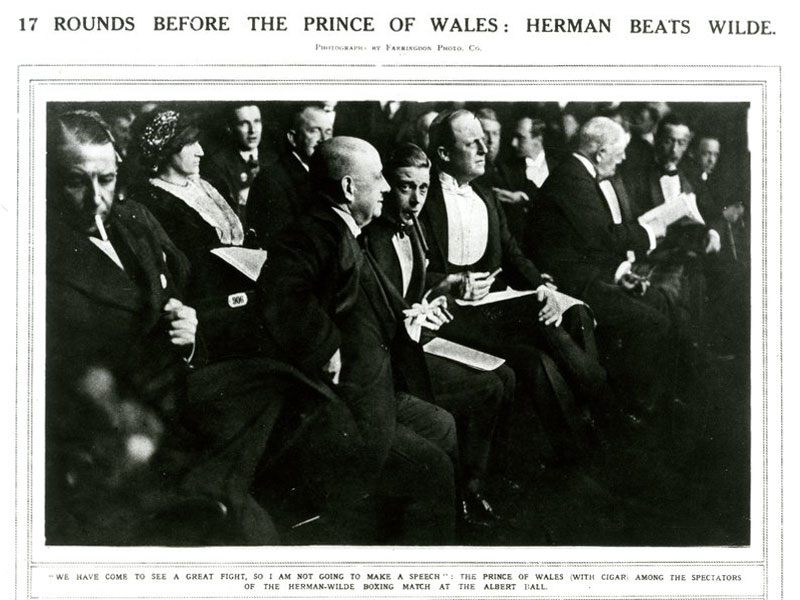
It was a significant event for Harry, not just because of his royal companion, but because prejudices that surrounded boxing, as recently as the 1914-18 Great War, had meant that a tournament in aid of the Hero Boxers’ Fund in the midst of war was officially declined by the Albert Hall ‘because pugilism was not the sort of thing to be associated with a building erected to the memory of Prince Albert!’
“The war had by then swept men’s minds clean of the last cobwebs of snobbery and humbug left over from the Victorian era. The insult to boxers as men, and to boxing as a manly and honourable sport, implied by that war-time refusal to stage a boxing match for charity in the Albert hall, was wiped out.”
The Prince would join Harry for boxing events at the Albert Hall on several further occasions. Including in 1927, and the Baldock-Brown fight in 1931 when Prince George joined them too.
Harry’s increasing success with his Brighton hotels and his philanthropic activities eventually led him into the august company of Edward, Prince of Wales (later to become King Edward VIII), and his brothers George, Duke of York (later to become King George VI), and George, Duke of Kent.
From 1920 he staged a boxing tournament annually in the Brighton Dome in aid of the Royal Sussex County Hospital and the Royal Alexandra Hospital for Children. This event was a huge success, raising a great deal of money for these hospitals, largely because Harry managed to enlist the voluntary services of many top rank boxers and both the Prince of Wales and Duke of York as patrons.
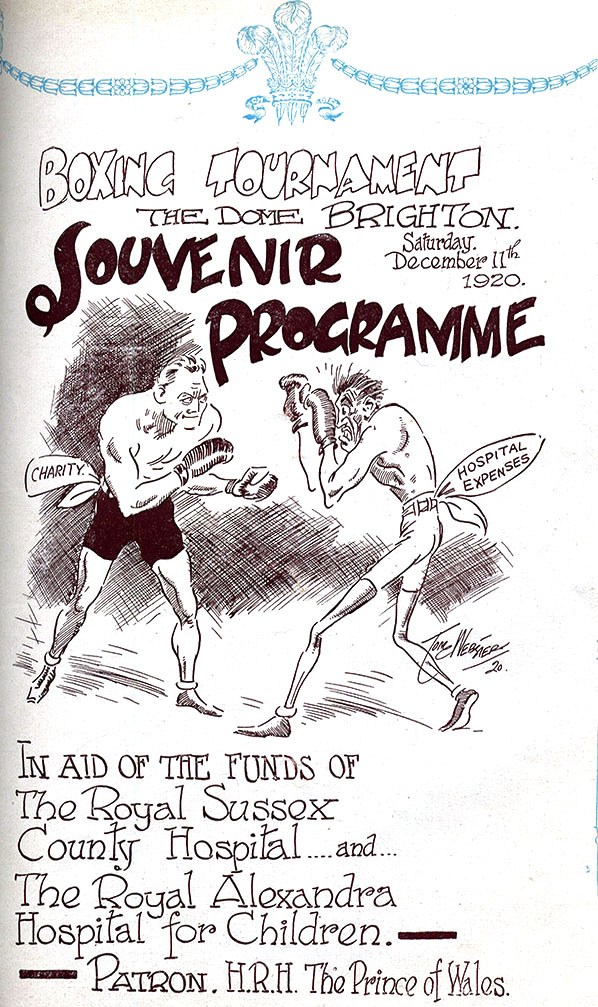
Harry gave exhibition bouts himself and the Prince would attend, stopping in the Royal Albion. Later, Harry would have the honour of being invited to dine with the Prince at both Manor House Hove and St James’s Palace.